Guest researcher in Space Physics
Rymdplasmafysik
We are seeking a highly motivated individual to join the Space Plasma Physics research program as a guest researcher to conduct research on magnetosphere-ionosphere coupling. The position is based at the Uppsala office of the Swedish Institute of Space Physics (IRF), located at Ångström Laboratory in Uppsala, Sweden. The successful candidate will work in a world-class international research environment with excellent opportunities for collaboration and scientific exchange.
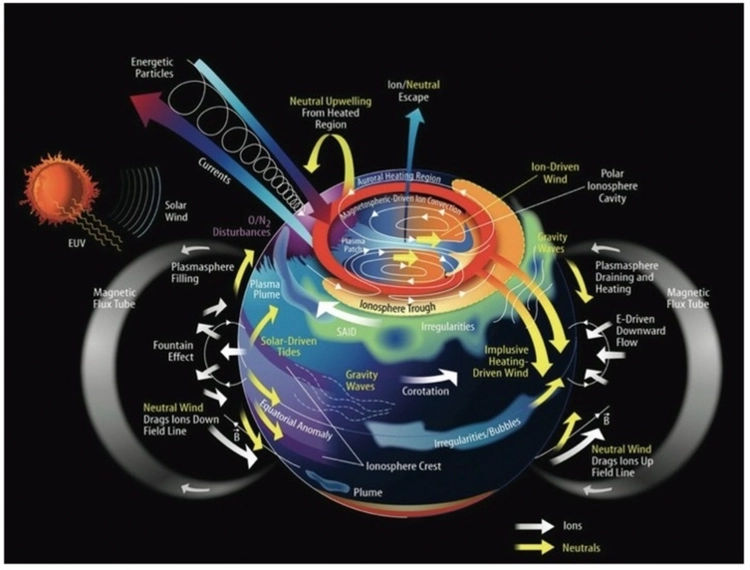
The position offers an opportunity to investigate how energy and momentum are transferred through the coupled magnetosphere–ionosphere–ground system. The scientific focus is on the role of field-aligned currents, plasma density, and temperature in controlling this coupling, and on how magnetospheric dynamics are ultimately manifested in the ionosphere and at the ground.
The research will combine a wide range of observations, including in situ measurements from Cluster, MMS, and THEMIS, ionospheric observations from Swarm, and ground-based measurements from magnetometers, radars, and all-sky imagers. Magnetospheric and ionospheric models will provide complementary information and help establish the physical mechanisms underlying the observations.
Particular emphasis will be placed on field-aligned currents generated by dynamic magnetospheric processes, including bursty bulk flows, and on tracing their effects from the magnetosphere through the ionosphere to the ground. An important goal is to determine how these processes contribute to observed ground signatures and what they reveal about space-weather-relevant magnetosphere–ionosphere coupling.
Our team specialises in observations, data analysis, and modeling of space plasma processes (IRF Space Plasma Physics). The group has decades of experience developing and operating instruments for spacecraft missions to measure electric fields, plasma temperature, density, and density fluctuations. These missions include BepiColombo, MMS, Solar Orbiter, Swarm, Cassini, Cluster, Rosetta, JUICE, and Comet Interceptor. IRF also has decades of expertise in conducting ground-based observations, including geomagnetic measurements and recordings with all-sky cameras, ionosondes, and radar (e.g., EISCAT).
Qualifications
The candidate must hold a PhD in space physics or a related field.
Experience with the analysis of satellite and/or ground-based observations relevant to magnetosphere–ionosphere coupling is strongly preferred. Experience with magnetospheric and ionospheric models, and their application to the interpretation of observations, is considered an advantage.
What we can offer you
We offer a workplace with flexible working hours, up to seven weeks of vacation per year, and comprehensive healthcare, including wellness programs and health benefits.
We are most proud to offer you a varied and interesting range of tasks, friendly colleagues, and a creative, independent workplace where everyone has their own responsibilities.
Equality, equal conditions, and diversity are fundamental principles in our workplace, and we work in an equality-integrated way, which means that we consider equality and inclusivity aspects in our daily work and in all decision-making forums.
Terms
The position is fully funded for a total duration of one year. The start date is flexible but should be no later than the spring of 2027.
The application should include a CV, a personal letter (maximum one page) describing research interests and relevant experience, copies of undergraduate and PhD degree certificates, description and proof of previous postdoctoral positions and/or similar relevant research work (if available), names and contact information for two professional references and reprints or open-access links of not more than 4 selected publications.
Swedish Institute of Space Physics (IRF) is a governmental research institute that conducts research and postgraduate education in space physics, atmospheric physics, and space technology. Many of IRF’s projects are run as large international projects in collaboration with other research institutes and space agencies. IRF has about one hundred employees and has offices in Kiruna (headquarters), Umeå, Uppsala, and Lund. For more information about IRF: www.irf.se
Swedish Institute of Space Physics (IRF) is a governmental research institute that conducts postgraduate education and research in space physics, atmospheric physics and space technology. Many of IRF's projects are run as large international projects in collaboration with other research institutes and space agencies. IRF has about one hundred employees and offices in Kiruna (headquarters), Umeå, Uppsala and Lund. More information about IRF.