 ESA
IRF play leading role in ESA’s new seven-spacecraft mission
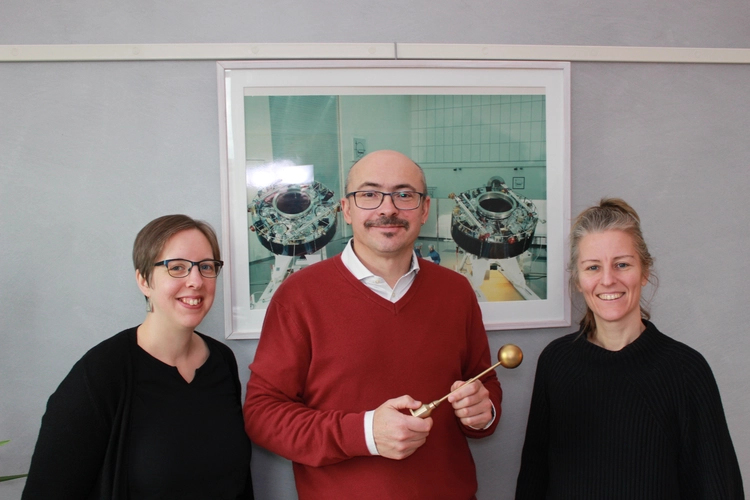
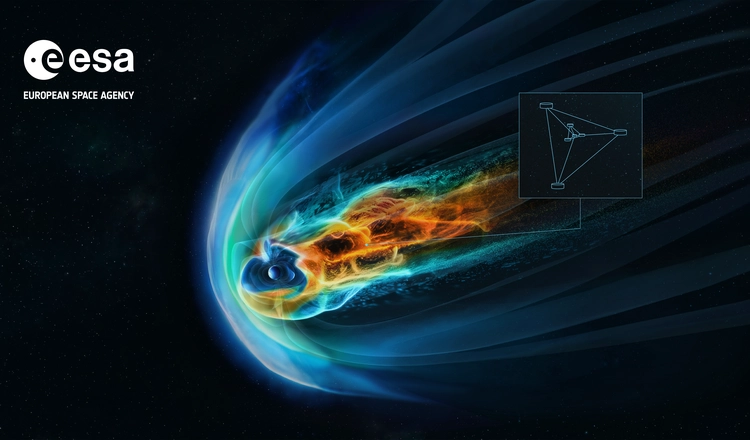
The European Space Agency (ESA) has selected Plasma Observatory as its next medium-class science mission. Its seven coordinated spacecraft will, for the first time, track how the Sun’s energy moves through Earth’s magnetic shield across different scales of distance and time. The Swedish Institute of Space Physics (IRF) has contributed to the development of the mission concept and will play a leading role in the mission, leading the development of the WAVES instrument suite.
Plasma Observatory,will study how electrically charged particles (plasma) from the Sun interactswith Earth’s protective magnetic bubble, the magnetosphere. These interactions drive processes that produce geomagneticsolarstorms, the northern lights, affect spacecraftsand astrounauts in space,and generate electrical currents in power grids on Earth.
Understanding these processes is becoming increasingly important as society grows more dependent on space-based technologies. TAlthough the Sun is the main driver of the near-Earth space environment, and many fundamental questions remain about how solar energy enters Earth’s magnetosphere, how it is transported,and how it is transferred to particles.
Plasma makes up of more than 99% of the visible Universe. By using Earth’s magnetosphere as a natural laboratory, the mission will also provide insights into fundamental plasma processes occurring throughout the universe – from the solar wind and stellar explosions to distant galaxiesdistance galazies.
Earth’s magnetosphere is one of the few places in the Universe where we can study plasma processes directly and in great detail. With seven spacecraft and sophisticated instruments, Plasma Observatory will take these measurements to an entirely new level. Exploring new regions of space is essential, but much of the Universe will always remain beyond our reach. To understand what happens there, we must understand the fundamental physics of plasmas. By using Earth’s magnetosphere as a natural laboratory, Plasma Observatory will help us build a more quantitative understanding of the processes that govern plasmas throughout the Universe, says Professor Yuri Khotyaintsev at IRF, lead scientist for WAVES and Box-W.
Seven spacecraft offer a new perspective
Previous space missions, including ESA’s Cluster mission with four spacecraft, have transformed our understanding of space plasma by allowing scientists to distinguish between changes caused by differences in locations and changes occurring over time.
Plasma Observatory will take the next major step by using seven spacecraft to make coordinated measurements at the same time. This will allow researchers to investigate how small, rapid processes are connected to larger changes across key regions of the magnetosphere. This way, scientists can see both the fine detail and the big picture at the same time.
Having worked extensively with multi-spacecraft data from missions such as ESA’s Cluster and NASA’s Magnetospheric Multiscale, I have seen first-hand how multiple measurement points open up entirely new possibilities compared with single-spacecraft observations. I am convinced that moving to a seven-spacecraft constellation will bring another qualitative leap in our ability to investigate space plasma processes and understand how they work, says Dr Cecilia Norgren, researcher at IRF.
IRF leads development of the WAVES instrument suite
IRF in Uppsala is leading the development of WAVES. WAVES will measure waves and fluctuations in space plasma using electric and magnetic field sensors connected to a common electronics unit, known as Box-W.
IRF is responsible for the development of Box-W and the spin-plane double probe (SDP), one of the two electric field sensors.
The development builds on IRF’s extensive experience in designing and building scientific instruments for international space missions, including ESA’s Cluster, Solar Orbiter, JUICE and Comet Interceptor.
Building seven identical instruments is a significant technical and organisational challenge, but one that we are looking forward to. It requires careful planning, close coordination and excellent collaboration with our international WAVES partners. Ensuring that all seven instruments perform consistently will be essential for achieving the mission’s scientific goals, says Vicki Cripps, research engineer at IRF.