 IRF
Rocket launch helps scientists investigate the northern lights
On 11 November 2026, the SYSTER/COUSIN sounding rocket was launched from Esrange Space Center near Kiruna, Sweden. Researchers from the Swedish Institute of Space Physics (IRF) contributed ground-based observations of the northern lights, helping to investigate how energy from space is transferred to Earth’s upper atmosphere.
The northern lights are a visible result of the interaction between Earth and space. They occur through the interaction between the solar wind and Earth’s magnetic field. When energy from the solar wind is transferred into Earth’s magnetosphere, charged particles can be accelerated along magnetic field lines towards the polar regions. As these particles collide with atoms and molecules in Earth’s upper atmosphere, light is emitted, creating the colourful displays we know as the northern lights. These are complex physical processes that scientists are still working to understand.
Studying the northern lights from above and below
During its flight, the rocket carried scientific instruments to altitudes of more than 100 kilometres, measuring charged particles, electric fields and conditions in the upper atmosphere.
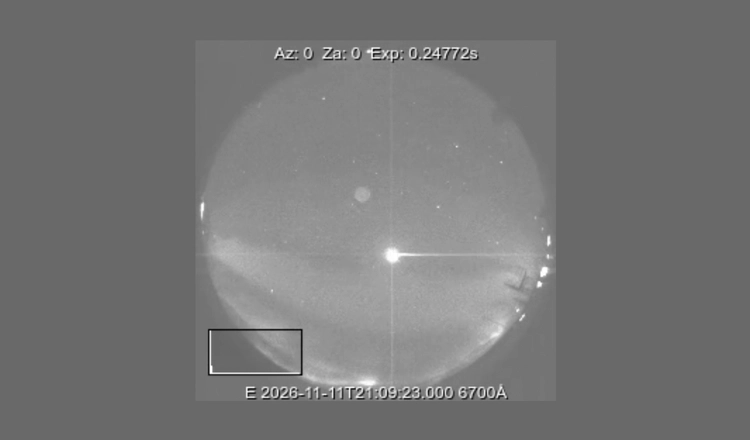
At the same time, researchers from IRF and collaborating institutions observed the northern lights from the ground using ground-based instruments such as ALIS_4D, cameras and spectrometers. While the rocket provided detailed measurements along its flight path, the ground-based instruments offered a much broader view of the northern lights and how they changed over time.
By combining these two perspectives, researchers can connect measurements taken within auroral structures during the rocket’s flight with the movements observed from the ground.
The measurements collected during the campaign will now be analysed to better understand how energy from space is transferred into our atmosphere.
A challenging launch
Launching a research rocket into the northern lights requires more than favourable weather.
Scientists need the right type of auroral activity, clear skies for ground-based observations and suitable wind conditions for a safe launch. All these conditions must occur at the same time, making the timing of the launch particularly challenging.
The campaign therefore required close coordination between the rocket team at Esrange and researchers operating scientific instruments on the ground.
What is a sounding rocket?
A sounding rocket is a research rocket used to carry scientific instruments to high altitudes for a short period of time. Unlike rockets that launch satellites into orbit, sounding rockets travel into space without entering orbit around Earth, before returning to the ground.
They allow scientists to conduct experiments and take measurements in parts of the atmosphere that are difficult to study from the ground.