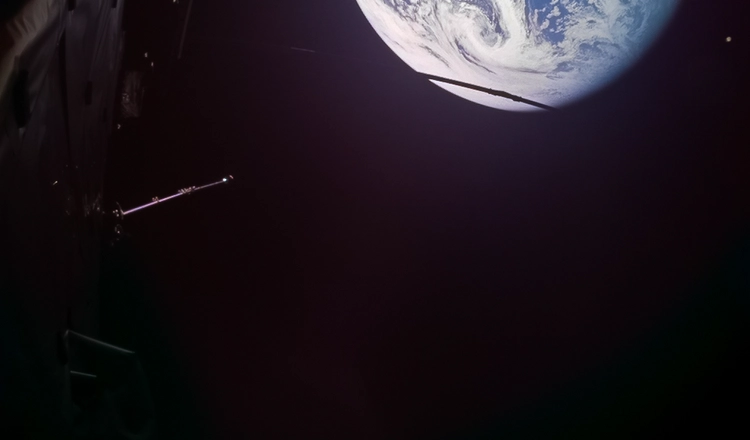
 ESA/Juice/JMC
RPWI performs measurments and calibration on its way to Jupiter
For ten hours, the European Space Agency ESA rotated its Juice spacecraft once per hour. The main purpose was to calibrate Radio & Plasma Wave Investigation (RPWI). It was the first time that RPWI had determined how Juice should be oriented in space.
The calibration was part of a longer RPWI measurement period in connection with Juice’s Earth flyby. The instrument was switched on on 23 September and is carrying out observations and calibrations until 3 October.
The measurments have so far exceeded our expectations, says Jan Bergman, technical manager for RPWI
RPWI is led by the Swedish Institute of Space Physics, IRF, in Uppsala and will measure electric and magnetic fields, radio waves and plasma in the environment around Jupiter. During the long journey to Jupiter, flybys are used to test and calibrate the instrument ahead of its future measurements at Jupiter and its icy moons.
Radio emissions from Earth used for calibration
The ten-hour rotation manoeuvre went according to plan. As Juice rotated, RPWI (Radio & Plasma Wave Investigation) was able to use strong radio emissions from Earth’s northern and southern auroral regions to calibrate the three antennas of RWI (Radio Wave Instrument).
We are still analysing the calibration data, but we can already say that the results look promising. The northern and southern auroral regions were very active during the ten-hour period, says Jan Bergman
RPWI also had a unique opportunity to make measurements during a four-day passage into and through Earth’s magnetotail. The measurements began while Juice was still about 4.8 million kilometres from Earth, approximately 12 times the distance between Earth and the Moon.
First extended period in shadow
The flyby presented Juice with another new situation. For the first time since its launch in 2023, the spacecraft spent an extended period in Earth’s shadow, without direct sunlight.
Juice was in partial shadow from the evening of 27 September until the morning of 28 September, after which it spent nearly three hours in full shadow. During the period of full shadow, the spacecraft had to rely on its batteries and almost all scientific instruments were switched off.
RPWI was switched off during most of the period in full shadow, but two short measurements of around five minutes each were carried out as Juice entered and exited full shadow.
The passage through Earth’s shadow provided a test of how RPWI is affected when the instrument first cools down in shadow and then warms up again in sunlight.
Even with RPWI’s survival heaters switched on, the temperature of RWI dropped from plus 36 degrees Celsius to minus 60 degrees Celsius after only two hours in shadow. The instrument is designed to withstand temperatures as low as minus 170 degrees Celsius.
Preparing for Jupiter
This is not the first time RPWI has used a flyby for scientific observations and calibrations. During Juice’s Moon-Earth flyby in 2024, the instrument made measurements in the environments around Earth and the Moon. Among other things, RPWI detected radio waves from Earth.
RPWI will be switched off again on 3 October, but planning for the next measurement period has already begun. The instrument will next be switched on in February 2027, when Juice will be in a completely different space environment, somewhere between the orbits of Earth and Mars.