
JNA wakes up after three years in space - making its first observations.
After three years of planned rest in space, the IRF-built Jovian Neutrals Analyzer (JNA) has been fully powered on for the first time. Now, after being successfully switched on, the instrument is making its first real scientific observations, as the European Space Agency ESA’s Juice spacecraft passes Earth for a gravity assist today, 28 September.
JNA was designed and built at the Swedish Institute of Space Physics, IRF, in Kiruna and is one of the six sensors included in the IRF-led instrument Particle Environment Package (PEP) onboard Juice. The spacecraft was launched in 2023 and is currently on its eight-year journey to Jupiter and its icy moons. JNA is designed to detect energetic neutral atoms (ENAs) – fast-moving neutral particles that allow the instrument to remotely ”see” the space environment around a planet.
While many of Juice’s instruments have already been switched on and made observations during the journey, JNA has remained inactive. The long wait has allowed gases trapped in materials and on surfaces inside the sensor to slowly escape into space – a process known as outgassing. This reduces the risk of electrical discharges when JNA’s high-voltage system is switched on.
Up until now, JNA has only been operated at low voltages to check the health of the instrument and verify that it responds correctly to commands, without putting the instrument at risk.
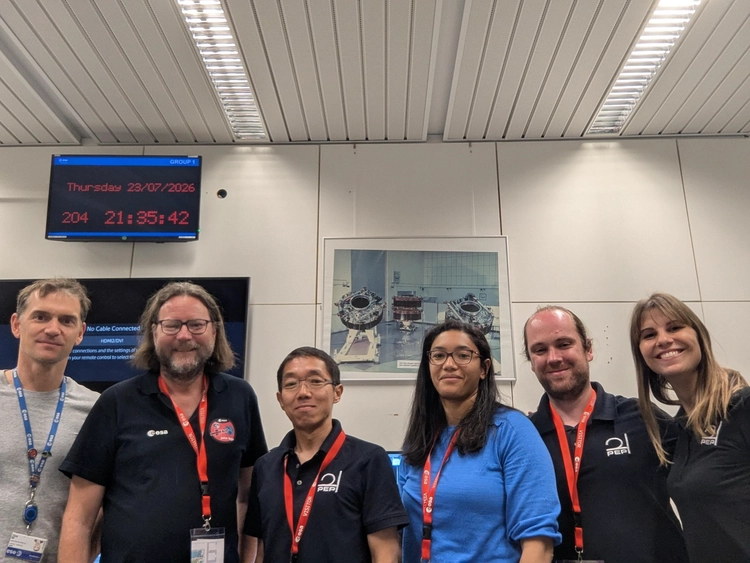
A 20-hour wake up
In July, members of the PEP team travelled to ESA’s European Space Operations Centre (ESOC) in Darmstadt, Germany, for the critical first full power-on of JNA in Space.
Over the course of 20 hours, the team gradually increased the instrument’s high voltages, and finally JNA was ready to detect signals in space.
“It was a special moment for the team. The last time JNA had been fully operational to measure particles was during its calibration campaign in IRF’s vacuum chamber in Kiruna, more than six years ago, before the instrument was mounted on Juice.”, says IRF-scientist Manabu Shimoyama, JNA sensor lead.
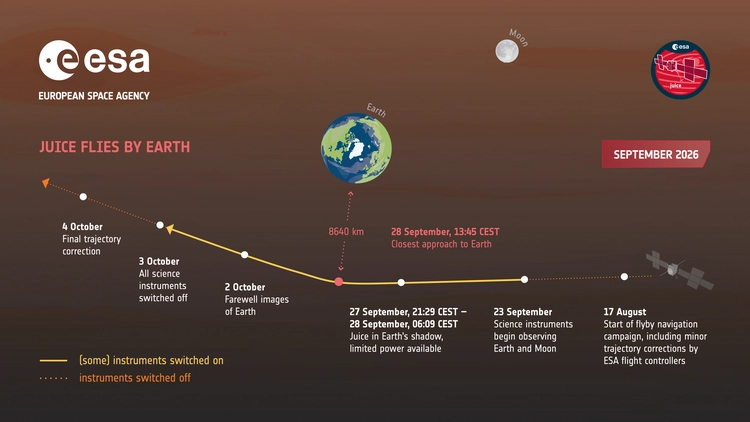
First real observations during Earth flyby
Before reaching Jupiter, JNA is getting its first opportunity to make real scientific observations in space.
Today, 28 September, Juice will return to Earth for a gravity assist. The spacecraft will pass around 8,640 kilometers from Earth, using our planet’s gravity to alter its path and increase its speed by around 3.5 kilometers per second. The manoeuvre is one of several planetary flybys that allow Juice to reach Jupiter without carrying an enormous amount of fuel.
During the encounter, Juice’s scientific instruments will be switched on and use Earth as well as the moon, to collect and analyse data from actual objects in space.
JNA is expected to observe the outermost region of Earth’s atmosphere and the surrounding space environment
“The Earth flyby is a great opportunity for us to check how JNA is performing with real signals from Earth’s space environment. It will help us make sure JNA is working as expected and give us confidence as we prepare for the much more challenging observations at Jupiter.”, says Manabu Shimoyama.
Juice will make one final Earth flyby in January 2029 before arriving at Jupiter in July 2031.
There, after years of development at IRF in Kiruna, and an eight-year journey through the Solar System, JNA will finally begin the observations it was built for.