 ESA
ESAESA extends several space missions involving IRF
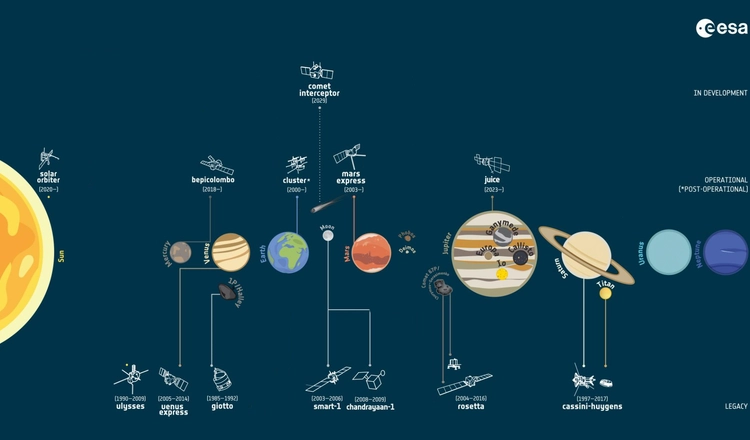
The European Space Agency (ESA) has decided to extend several of its scientific space missions. Among the missions receiving continued support are three projects involving the Swedish Institute of Space Physics (IRF): BepiColombo, Mars Express and Solar Orbiter. At the same time, the proposed future mission Plasma Observatory has been recommended to proceed to the next phase of ESA’s Science Programme.
The decision was made by ESA’s Science Programme Committee. The extensions will allow the missions to continue collecting valuable scientific data and contributing to new research in the years ahead.
BepiColombo continues the journey towards Mercury
European Space Agency (ESA) and Japan Aerospace Exploration Agency’s (JAXA) joint mission to Mercury, BepiColombo, includes three instruments contributed by the Swedish Institute of Space Physics (IRF), developed by scientists and engineers in Kiruna and Uppsala. These instruments will be used to study plasma and energetic particles in Mercury’s surrounding environment.
The two spacecraft that make up BepiColombo are expected to arrive at Mercury at the end of 2026. Once there, they will enter separate orbits around the planet and carry out scientific observations for at least one year.
Continued research on March
Mars Express is the first European spacecraft to orbit Mars and has been studying the planet since 2003. IRF in Kiruna contributes to the mission through the ASPERA-3 instrument, which is used to investigate the interaction between the solar wind and the Martian atmosphere.
Solar Orbiter continues exploring the sun
The extension is particularly important for Solar Orbiter. The mission studies the Sun up close and is providing humanity with its first views of the Sun’s polar regions. IRF contributes to the mission through components of the Radio and Plasma Waves (RPW) instrument, which measures electric fields.
The continued exploration of the Sun by Solar Orbiter will provide new perspectives on our star and create opportunities for entirely new discoveries.
Plasma Observatory recommended for the next phase
In addition to the mission extensions, ESA’s Science Programme Committee recommended that Plasma Observatory proceed to the next phase of ESA’s Science Programme. The mission consists of seven identical spacecraft that will be placed in orbit around Earth.
IRF in Uppsala is leading the development of WAVES, one of the two instrument suites aboard the spacecraft. WAVES will measure waves in space plasma and consists of sensors for measuring electric and magnetic fields, operated through a common electronics unit.
Dr. Cecilia Norgren and Professor Yuri Khotyaintsev are members of the mission’s ESA Science Study Team.