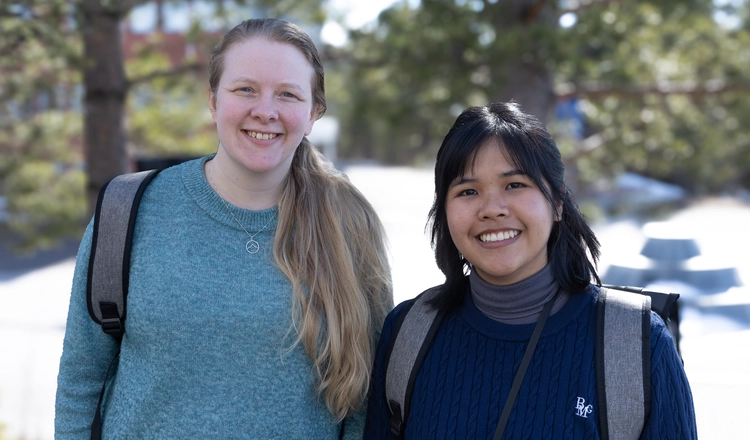
From the Moon to Earth’s upper atmosphere – new PhD student and scientist at IRF
From lunar research and space instrumentation to studies of Earth’s upper polar atmosphere — two new colleagues have recently arrived at Swedish Institute of Space Physics in Kiruna. Meet new PhD student Jidapa Lakronwat and scientist Lindis Merete Bjoland.
Jidapa Lakronwat
Originally from Thailand, Jidapa Lakronwat recently joined IRF as a PhD student within the Solar System and Space Technology research programme.
She holds a Master of Science in Physics from Mahidol University, where her earlier research focused on calibrating a Thai-developed space instrument prototype designed to detect and identify cosmic ray ions through balloon experiments.
During an internship at KTH Royal Institute of Technology in Sweden, Jidapa worked on recalibrating compact X-ray detectors called CUBES (CUBesat X-ray Explorer using Scintillators). The detectors are part of the payload planned for launch with the MIST (MIniature STudent satellite) mission, which will study the X-ray radiation environment in low Earth orbit and evaluate component performance.
At IRF, she will work with the NILS space instrument to study negative ions on the lunar surface.
My first impression of Kiruna is its beautiful landscape and very friendly people. At IRF, there are many interesting research projects and many people working on diverse and exciting topics,” she says.
Lindis Merete Bjoland
Lindis Merete Bjoland has recently joined IRF as a scientist within the Solar Terrestrial and Atmospheric Research Programme. She completed her Master studies at the University of Bergen before earning her PhD at UiT The Arctic University of Norway in 2018.
Following her PhD, Lindis held postdoctoral and researcher positions at the University Centre in Svalbard, the University of Bergen and the National Institute of Polar Research. Her earlier research focused on studying processes in the upper polar atmosphere using long-term data collected by the EISCAT radar systems.
At IRF, she will work with ionosondes — radar instruments that measure electron density in the upper atmosphere — and continue studying the upper polar atmosphere.
Everyone at IRF has been very welcoming and helpful during my first weeks, so it has been a really nice start,” she says. “I look forward to getting to know the people better and learning more about the exciting research projects they are working on.”