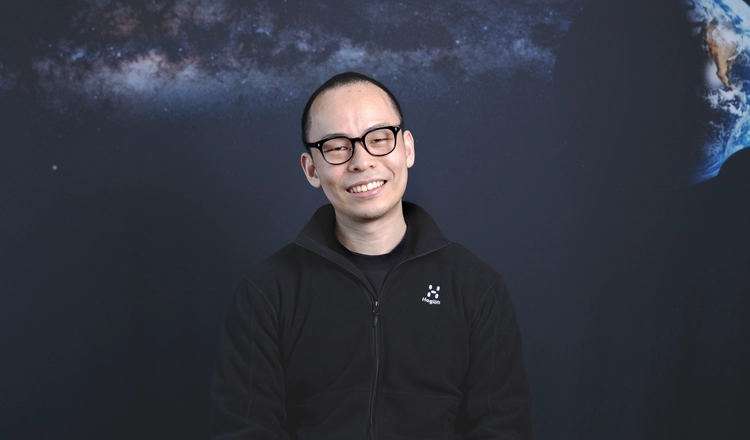
 Celine Lundqvist
Exploring the Aurora: A research perspective from postdoctoral scientist Sota Nanjo
The aurora is one of the most visible manifestations of processes taking place in near-Earth space. For postdoctoral scientist Sota Nanjo, at the Swedish Institute of Space Physics (IRF), it is not only a visual phenomenon, but also a source of scientific data.
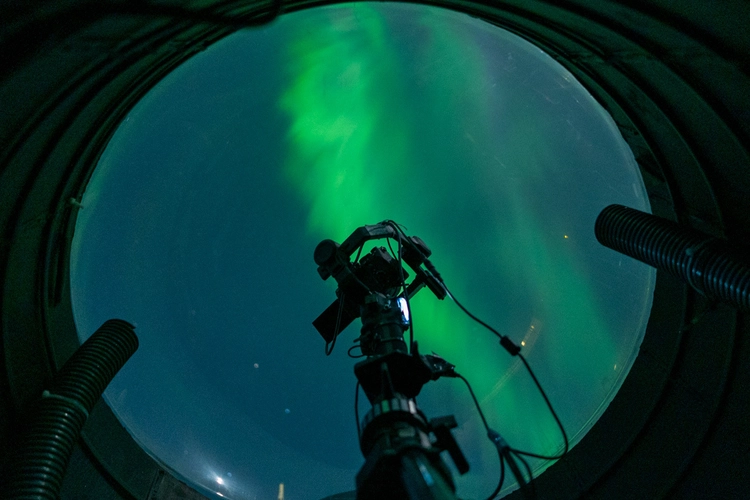
Groundbased cameras and photographic observations play a central role in auroral research. Unlike the human eye, cameras can capture faint structures record events over time and provide objective measurements that can be analyzed afterwards. This makes images of the aurora not just visual documentation, but a scientific tool for studying how energy and particles from the Sun interact with Earth’s atmosphere.
Sota Nanjo, studies the aurora by combining large datasets from cameras with measurements from radar, satellites and magnetometers. His work focuses on understanding the processes that lead to the formation of the aurora and what it can reveal about space weather and its impact on society.
How would you describe your research focus within auroral studies?
My research focuses mainly on observations, which are the foundation for understanding auroral processes.
How are simulations used in auroral research?
Observations show what happens at a specific place and time, while simulations help us understand how these processes develop across larger regions.
For example, by using data about the solar wind and Earth’s magnetic field, we can estimate where the aurora might appear and how strong it could be. This is the same method used in many aurora forecast apps.
In research, we combine models of the solar wind, magnetosphere, ionosphere and atmosphere to better understand how these processes connect to the aurora.
How do you use ground based camera data in your research?
Camera data shows when and where the aurora appears. We combine this with measurements from radar, magnetometers and satellites to study how energy and particles move in space.
Cameras capture the light emitted by the aurora, but not the particles themselves. To fully understand the process involved, we also rely on direct particle measurements, for example from satellites. These methods complement each other.
How does scientific analysis of the aurora differ from how we experience it with the naked eye?
Cameras are much more sensitive than the human eye and provide objective, continuous measurements. They allow us to record, replay and analyze events, which is not possible through visual observation alone.
You have collaborated with photographers outside academia - what did that add to your research?
In places like Kiruna, we have regular observations. However, at lower latitudes, aurora is rare and scientific data may be limited. In those cases, photographs taken by the public can provide valuable additional information.
What led you to study the aurora?
In Japan, students start independent research in their final undergraduate year. My university focused on information and communication, but I was more interested in natural phenomena. There was a professor studying aurora so I chose this field.
Has your perspective on aurora changed through your research?
I was drawn to research because I liked working with questions that do not have clear answers and that has not changed.
At first I mainly saw aurora photographs as something beautiful. Today, I focus more on how these images are produced. Instead of only appreciating the visual impression, I ask what physical processes they represent and how much is influenced by the way the image is captured and processed.
Why did you choose IRF?
The optical domes on campus were a deciding factor, they allow us to make observations regularly under controlled conditions. My former supervisor in Japan also had connections with IRF so it felt like a natural option for me.
People at IRF are kind, and I have the freedom to focus on what I’m interested in.
The collaborative environment is important – research depends not only on instruments, but also on discussion and exchange of ideas.
What motivates you in your work?
The most exciting part is finding a clear explanation for something that is not yet fully understood.
I also enjoy being involved in the entire research process, from observation to publication.
What are the next questions in auroral research that you think are important to solve?
A key challenge is to understand the full chain of events: from how energy enters Earth’s magnetic environment to how it ultimately is expressed as auroral light.
Another important task is to connect this knowledge to real-world impacts. Space weather can affect infrastructure, communication and navigation systems.
To improve both understanding and prediction, we need to combine observations, simulations and different types of data.