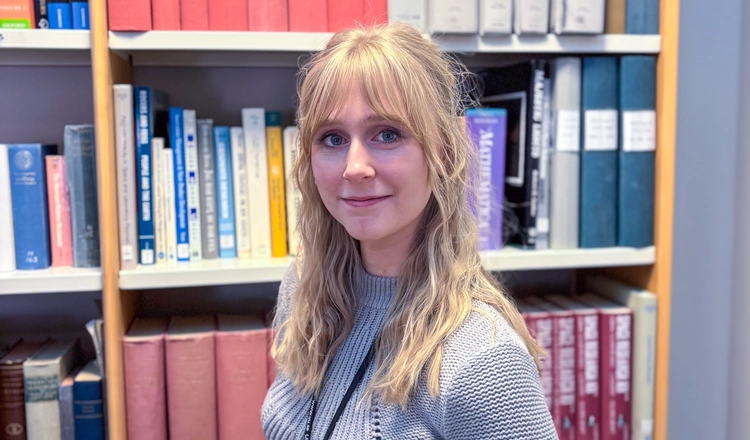
 Konstantin Kim/IRF
From solar storms to power grids – Alice studies the impact of space weather
How do solar storms affect our society on Earth? Doctoral student Alice Wallner at the Swedish Institute of Space Physics (IRF) studies how space weather can disrupt the Swedish power grid – an area of great importance for the future energy supply.
Tracing effects from the sun all the way down to an individual transformer in the Swedish power grid is a central part of Alice’s research.
What is your background and what have you studied?
Before coming to Uppsala and IRF, I studied a Master of Science in Electrical Engineering at the Royal Institute of Technology (KTH). Electrical engineering wasn’t always my thing or something I was particularly passionate about, but there was a master’s program in electromagnetism, fusion and space technology that attracted me! I’ve been fascinated by space ever since I was little and saw Fuglesang go up to the ISS on TV in the middle of the night. So after my bachelor’s in electrical engineering, I started that master’s program and specialized in space physics within it, completely in line with my somewhat far-fetched plan to study electrical engineering.
Where are you from?
I come from Stockholm where I grew up and studied until my doctoral studies which I moved to Uppsala for.
How did you become interested in space weather?
I didn’t know much about space weather when I applied for the PhD position, but I quickly realized that this was something for me. Space weather connects space physics with its impact that is actually noticeable to us humans in everyday life. That is something I find very rare when you delve deeper and deeper into physics. Also the opportunity to see the whole through all the small and large processes that link to the next and together form this chain of events and phenomena that ultimately cause noticeable effects – I think that is the best!
What made you choose IRF and Uppsala?
At KTH I heard from both PhD students and professors that IRF is one of the leading institutes for space physics in the world and especially in Sweden, so IRF was always in the back of my mind. Then I would say that it was a lucky coincidence that I ended up here. Tomas Karlsson at KTH, who taught the courses in space physics that I studied, sent a link to this PhD position and said that it might be something for me. So I applied and hoped for the best but saw it more as a practice opportunity – but now I am sitting here at IRF and I am very happy!
What is your research about?
My research is about how space weather, more specifically solar storms, affect the Swedish power grid. During solar storms, the Earth’s magnetic field is affected, which gives rise to electric fields in the ground. The power grid and, for example, train tracks are grounded in the ground, and the induced electric field can then enter these in the form of geomagnetically induced currents. These currents can disrupt the normal functioning of the power grid and overheat transformers, which is harmful and very expensive to repair. So my research actually extends all the way from the sun down to specific transformers to try to figure out exactly what it was in space that caused the disturbance here on Earth.
What is space weather and geomagnetically induced currents, and why is it important?
Space weather is, like the regular weather they talk about on SVT, the state of our surroundings and environment right now. Then it differs a little considering that space weather is everywhere between the sun and the earth while SVT’s weather usually extends approximately up to the cloud cover. Space weather affects a variety of different phenomena - for example, the northern lights are a symptom of space weather, radiation on satellites and astronauts, disturbances in GPS systems due to changes in the ionosphere and much more.
Geomagnetically induced currents are my subject and therefore of course the most interesting and it is also important as a really big solar storm can knock out parts of (or the whole of in the worst case) the power grid, which in today’s society would be a minor disaster as we don’t get far without electricity.
In space weather, people usually talk about the Carrington storm. It is the largest solar storm ever documented. The Carrington storm erupted in 1859, and so far such a large storm has not occurred in modern times, so we still do not know how bad the effects of a solar storm of that strength could be. Therefore, it is important to research and see which processes are most dangerous and which power lines are in bad shape in different situations.
How can your research affect, for example, power grids or other infrastructure?
In my work, I collaborate with Svenska kraftnät, the The Swedish Defence Research Agency (FOI) and the Swedish Civil Defence and Resilience Agency (MCF) because space weather is very important to keep an eye on for the power grid, infrastructure and civil preparedness. With the help of the knowledge we can learn by researching geomagnetically induced currents, Svenska kraftnät, for example, can take action when there is a risk situation – and above all know exactly which situations are risk situations.
What are you doing specifically in your project right now?
In my first project as a PhD student, we investigated the largest solar storm in over 20 years that erupted in May 2024. From that study, we discovered that it is not quite as simple as looking for a certain level of unwanted current (geomagnetically induced current) to know when a fuse in a transformer will trip. It seems to be more complex, and by now focusing on a specific transformer in the Swedish electricity grid, we are now trying to see what it is that caused the fuse to blow there on three different occasions between 2003 and 2024, since it does not seem to be as simple as the level of current reaching a certain threshold value. We also want to investigate more closely what in space weather caused these two previous disturbances.
What has been the most educational experience during your first time at IRF?
I have learned a lot and have had the opportunity to try out a lot of different things over the past 1.5 years. I have spoken at an international conference, given a multitude of presentations, spoken on the radio, been a teaching assistant in a course on electromagnetic fields, written and published a scientific article and had international collaborations with other research groups. All of this has been incredibly educational and developing.
Something that is very important for learning is having a supportive supervisor who guides you through the lessons - and I really do! My supervisor Andrew Dimmock has not only made many of the experiences I listed above possible, but he has also supported, encouraged and challenged me, which has really benefited my learning.
What do you find most exciting about your research?
Everything! Perhaps the most exciting thing is being able to trace back what we know happened on Earth, to currents in the ionosphere, to the interaction between the solar wind and the Earth’s magnetic field, to finally the eruption from the sun. The fact that it is possible to understand and trace such a complicated chain is truly inspiring!
What do you do when you are not doing research?
Unfortunately, lately it has been a lot of relaxing on my couch at home when I am not working… But when I am not relaxing, I like to spend time with friends, read and paint! Crocheting can also be a relaxing activity when you have used your brain all day.
What are your dreams for the future?
I would like to continue researching space weather. I really like the way I work and the tasks I have now, everything from research to teaching, so a career in academia is my dream.