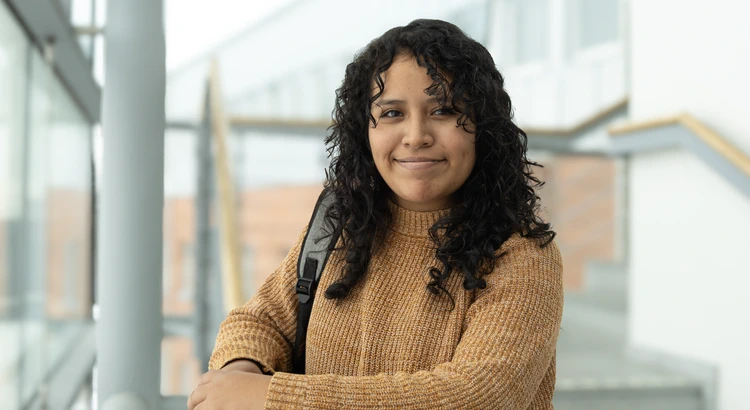
New PhD student at IRF to improve tracking of satellites and space debris
How does Earth’s atmosphere affect our ability to track satellites and space debris? This is one of the questions that Jhassmin Aricoche Del Campo, a new PhD student at the Swedish Institute of Space Physics (IRF), will study in Kiruna.
As a first-generation college graduate, Jhassmin Aricoche Del Campo holds a bachelor’s degree in electronic engineering from Universidad Nacional del Callao in Peru. Her interest in the field began early during an internship at Jicamarca Radio Observatory, where she later completed her undergraduate thesis and worked as an electronics engineer.
She then moved to the United States to pursue a Master of Science in Electrical and Computer Engineering at Cornell University. During her studies, she also completed a summer internship at NASA Goddard Space Flight Center, supported by the Universities Space Research Association.
Research at IRF
Jhassmin is now a PhD student at IRF, within the Solar Terrestrial and Atmospheric Research Programme, where her research focuses on how the ionosphere - the layer of electrically charged particles in Earth’s upper atmosphere - affects radio wave propagation. Her work is closely linked to EISCAT_3D, a next-generation radar system in northern Scandinavia.
I will investigate how the highly variable ionosphere at these latitudes affects the quality of orbit measurements. I also want to understand how well these effects can be corrected using radar measurements of electron density, and how the radar system’s properties can be used to better characterize space objects, for example by estimating their size.
Why it matters
Her research has important implications for space situational awareness - the ability to monitor and track objects in orbit. As the number of satellites continues to grow rapidly, so does the need to detect and understand even small particles of space debris.
In simple terms, I work on improving observations of space objects like meteors and debris using instruments in northern Sweden. This is important because all space objects need to be monitored, and improving our ability to detect smaller particles has real societal value.
What attracted her to IRF was not only the research project itself, but also the interdisciplinary, collaborative, and internationally recognized research environment.
She hopes her work will enable radar data from EISCAT - and in the future primarily EISCAT_3D - to contribute more extensively to the mapping of space objects. She also aims to produce impactful scientific publications so that the models she develops can be used by other scientists and engineers in the future.
Life in Kiruna and the future
What excites her most about the field is the combination of advanced instrumentation and modeling.
I find it exciting to work with different instruments - such as radars, GPS, and digisondes - and to develop models that help characterize the ionosphere using the latest techniques".
Moving from a region near the Equator to the Arctic has been a major change.
At first, I was a bit worried about the weather and about moving to a city that is actually relocating due to mining,” she says. “But I’ve discovered that Kiruna has much to offer beyond science. The town is lively, and there is plenty of nature to explore.”
She is especially looking forward to seeing as many auroras as possible and learning how to ski.
Looking ahead, Jhassmin hopes to continue in academia or research.
I dream of becoming a professor or research scientist, so I can guide new generations of scientists in Peru, share my knowledge, and work on many exciting projects in the future.