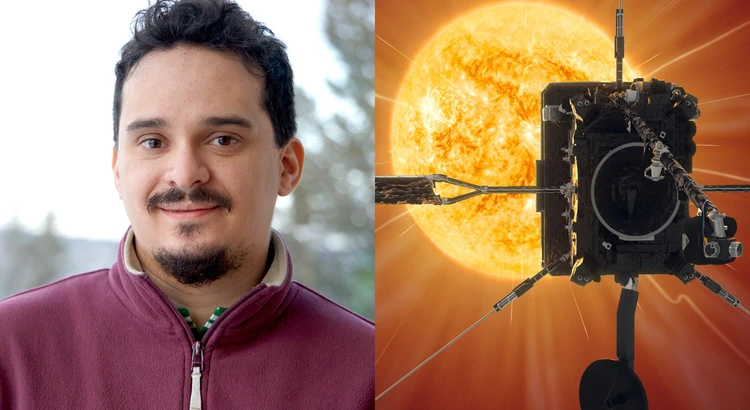
 Photo: IRF. Illustration: ESA
Solar wind waves shape our space environment
Different types of plasma waves occur frequently in the solar wind close to the Sun and play a key role in redistributing energy among particles as the solar wind expands through the solar system. This is one of the main findings in the doctoral thesis of Jordi Boldú at the Swedish Institute of Space Physics (IRF) and Uppsala University.
The solar wind is a stream of charged particles continuously flowing from the Sun, filling the space between planets with plasma. Waves in the solar wind travel through this plasma – a gas of charged particles – rather than through air or water as on Earth. These waves influence how energy moves through the solar wind. In his doctoral thesis, Jordi investigates which plasma waves are most common and how they redistribute energy.
A front-row seat to the Sun
Using data from the European Space Agency’s Solar Orbiter spacecraft, Jord identifies different types of waves in the solar wind. The spacecraft travels closer to the Sun than the orbit of Mercury, providing a unique opportunity to observe the solar wind near its source.
By analysing measurements taken close to the Sun, Jordi studied plasma waves at an earlier stage of the solar wind’s evolution than previously possible. The research improves our understanding of how plasma waves influence the solar wind and the space environment around Earth.
Particles resonating with waves
A key part of the thesis studies high frequency electrostatic waves, including Langmuir waves and ion-acoustic waves. These waves interact with particles in a special way: only particles moving at a certain speed can “sync” with the wave and exchange energy with it.
This process affects how the solar wind changes as it moves and is connected to phenomena such as space weather, shock waves in space, and the acceleration of high-energy particles.
High-frequency electrostatic waves play an important role in shaping the solar wind. By identifying which waves are most common, we can better understand how the solar wind evolves as it travel through the solar system. Solar Orbiter lets us study this process closer to the Sun than Mercury’s orbit, says Jordi.
Jordi Boldú, born in Mexico, will defend his doctoral thesis “The Role of Kinetic Waves in the Solar Wind Evolution” at 09.00 on Tuesday, March 24, in the Sonja Lyttkens Hall at the Ångström Laboratory in Uppsala. The opponent is Professor Xóchitl Blanco-Cano from the Universidad Nacional Autónoma de México (UNAM).
Contact: Jordi Boldú, PhD student, Swedish Institute of Space Physics, Uppsala, and Uppsala University, Jordi Boldu