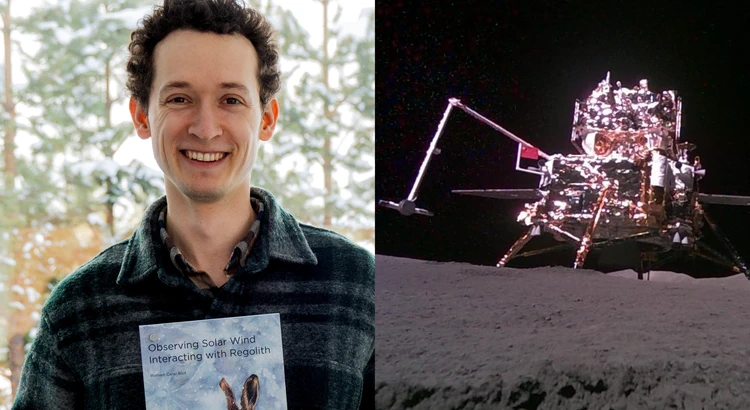
 IRF och CNSA, CLEP
Moon’s surface revealed as an efficient source of negative ions
Hydrogen atoms hitting the Moon’s surface may bounce back into space instead of sticking to the lunar soil. Many of them leave the surface carrying a negative charge. This result comes from the doctoral research by Romain Canu-Blot, based on measurements from an instrument designed to study how particles interact with the Moon’s surface.
During his doctoral studies at the Swedish Institute of Space Physics (IRF) in Kiruna and Umeå University, Romain studied regolith – the loose often fine grained rocky material covering the surfaces of planetary bodies such as moons, comets and asteroids. One way to study regolith is by examining the products of its interactions with incident atomic particles, for example from precipitating solar wind.
As part of his research, Romain was deeply involved in the design, assembly and calibration of the particle instrument NILS (Negative Ions on the Lunar Surface) at IRF. NILS was designed to measure negative ions and electrons at the lunar surface. In June 2024, NILS landed on the Moon as part of China’s Chang’e-6 mission and successfully detected for the first time negative hydrogen ions on the lunar surface.
Building the instrument and analysing the data gave us a rare opportunity to study how particles interact with the Moon’s surface in situ. These measurements help to understand processes that occur on many atmosphereless bodies in the solar system, says Romain.
When low-energy particles impact a solid surface such as lunar regolith, several things can happen. The particles can stick to the surface, bounce back into space, or knock atoms out of the regolith material.
To understand these processes, Romain developed a new quantitative physical model describing how particles are reflected from surfaces and how atoms are ejected. He tested the model using measurements collected directly at the Moon.\
Using statistical methods known as Bayesian inference, he shows that hydrogen atoms leaving the Moon’s surface are surprisingly often negatively charged. Hydrogen atoms with energies of a few hundred electron-volts are also about twice as likely to directly bounce back into space as they are to eject secondary atoms from the surface.\
Romain Canu-Blot, born in France, will defend his doctoral thesis Observing Solar Wind Interacting with Regolith at 09.00 on March 23 in the auditorium at IRF in Kiruna. The opponent is Professor Dr.-Ing. Ralf Srama from the University of Stuttgart, Germany.\
Contact: Romain Canu-Blot, PhD student, Swedish Institute of Space Physics, Kiruna, and Umeå University, Romain Canu-blot (is no longer at IRF, instead – contact Communication)